
Red Dress Day on May 5 is a time to stand in solidarity with Indigenous women and communities
Today, May 5, is Red Dress Day, a national day of remembrance honouring the lives of Missing and Murdered Indigenous Women, Girls and 2SLGBTQIA+ People.
It’s also a day of learning and activism — let’s stand in solidarity, spread awareness and raise our voices against gender-based violence and the disproportionate harm that Indigenous women, girls and gender-diverse individuals face.
A few startling statistics from Government of Canada data:
- 43% of Indigenous women have been sexually assaulted at least once since the age of 15
- 63% of Indigenous women have experienced physical or sexual violence in their lifetime
- While only five per cent of the Canadian female population, they make up approximately 25% of all homicide victims
It was in 2010 that Métis artist Jaime Black-Morsette created the REDress Project as an art installation consisting of placing red dresses in public spaces as a call for justice for the missing and murdered Indigenous women.
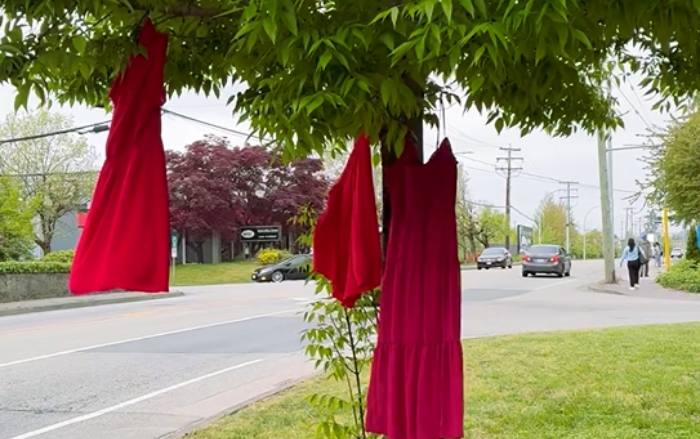
Since then, people across BC and Canada hang red dresses annually May 5 on trees, from balconies and in windows in a show of allyship, advocacy and as a powerful symbol of the lives lost and the justice still being fought for.
Other ways to stand in solidarity include:
- Wear a red dress or shirt
- Wear a red dress pin made by Indigenous designers
- Listen to and amplify Indigenous women’s voices and stories
- Speak out against violence
- Participate in local community events (see list below)
- Support Indigenous organizations
- Read resources and watch documentaries to educate yourself (see some resources below)
DIVERSEcity’s Gender-Based Violence team came together this morning to reflect, share information and help build awareness in the community by hanging red dresses in the trees in front of DIVERSEcity’s Surrey Community Campus on busy 76 Avenue.
“In our work supporting survivors, our Gender-Based Violence Services team at DIVERSEcity wants to add our voice in support of Indigenous women and girls, who are more likely to go missing or to be murdered than other women and girls. They are disproportionately impacted by violence and exploitation, due to interconnected factors such as systemic discrimination, poverty and more. Those same factors also keep their stories ignored or invisible,” says Faiza Attiqullah, Manager of DIVERSEcity’s Gender-Based Violence Services.
We must ask the difficult questions on why this crisis is ongoing and raise our voices to demand an end to it, so we can ensure safety for all women and girls.
Red Dress Day resources to learn more
National Inquiry into Missing and Murdered Indigenous Women and Girls mmiwg-ffada.ca/
Their Voices Will Guide Us educational engagement guide: mmiwg-ffada.ca/publications/
Sacred MMIWG education and awareness campaign: mmiwg-ffada.ca/sacred_mmiwg-ffada_sacrees-2/
Jaime Black-Morsette’s REDress Project: jaimeblackartist.com/exhibitions/
Truth and Reconciliation Commission’s 94 Calls to Action: rcaanc-cirnac.gc.ca/eng/1524494530110/1557511412801
Report of the Roundtable on Missing and Murdered Indigenous Women, Girls and 2SLGBTQI+ People rcaanc-cirnac.gc.ca/eng/1679082753194/1679082861365
Misko-Mjigodenh – The Red Dress documentary about advocate Nina Toulouse | Rogers tv
Women’s Warrior Song Women’s Warrior Song – 8000 Drums Sacred Ceremony: https://youtu.be/mlAZjca2YMo?si=6PVV1OW-qsaPv51f
MMIWG2S+ National Crisis Line at 1‑844‑413‑6649 is a national, toll-free 24/7 crisis call line providing support for anyone who requires emotional assistance related to Missing and Murdered Indigenous Women, Girls and 2SLGBTQI+ People in Canada.